(Plain Text Version)
When we were young children, we were outraged when someone took our toy away. We were angry because we lost something we wanted. But we were also angry at the injustice that happened. This sense of right and wrong is a gift from God, called the Natural Law.
Forgetting the Natural Law
As we go through life, we can lose track of right and wrong because of the influence of the people around us, our selfish desires, and the work of the devil. God gave us the Ten Commandments to remind us to do what is right.
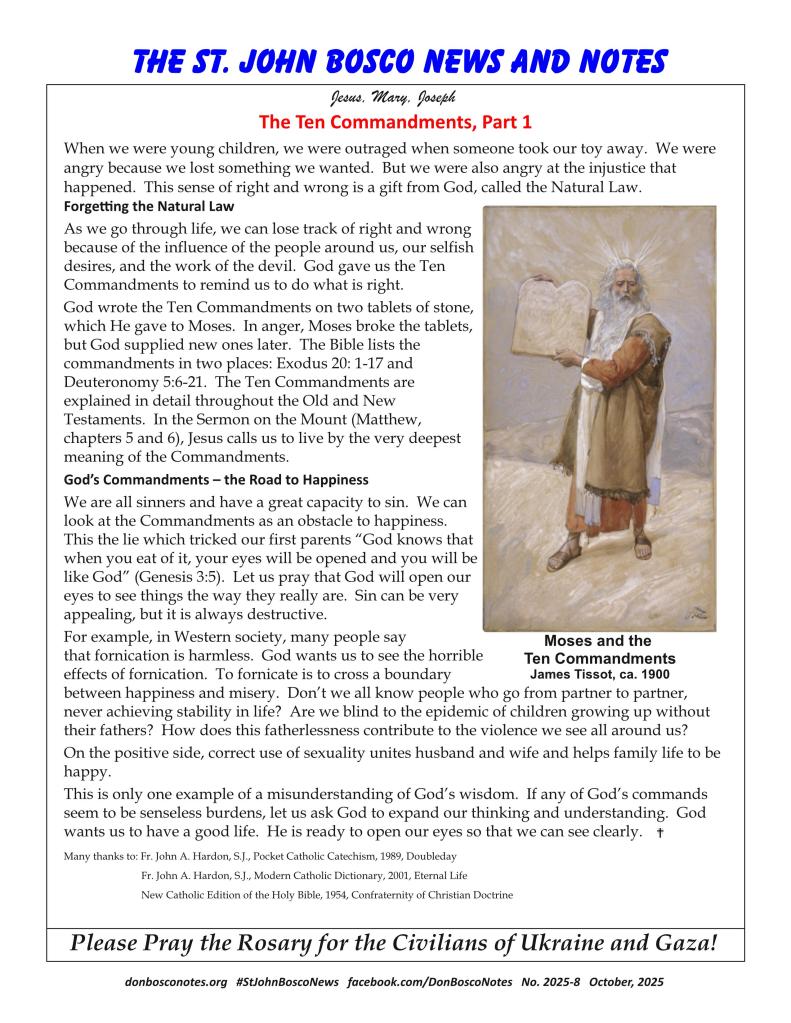
God wrote the Ten Commandments on two tablets of stone, which He gave to Moses. In anger, Moses broke the tablets, but God supplied new ones later. The Bible lists the commandments in two places: Exodus 20: 1-17 and Deuteronomy 5:6-21. The Ten Commandments are explained in detail throughout the Old and New Testaments. In the Sermon on the Mount (Matthew, chapters 5 and 6), Jesus calls us to live by the very deepest meaning of the Commandments.
God’s Commandments – the Road to Happiness
We are all sinners and have a great capacity to sin. We can look at the Commandments as an obstacle to happiness. This the lie which tricked our first parents “God knows that when you eat of it, your eyes will be opened and you will be like God” (Genesis 3:5). Let us pray that God will open our eyes to see things the way they really are. Sin can be very appealing, but it is always destructive.
For example, in Western society, many people say that fornication is harmless. God wants us to see the horrible effects of fornication. To fornicate is to cross a boundary between happiness and misery. Don’t we all know people who go from partner to partner, never achieving stability in life? Are we blind to the epidemic of children growing up without their fathers? How does this fatherlessness contribute to the violence we see all around us?
On the positive side, correct use of sexuality unites husband and wife and helps family life to be happy.
This is only one example of a misunderstanding of God’s wisdom. If any of God’s commands seem to be senseless burdens, let us ask God to expand our thinking and understanding. God wants us to have a good life. He is ready to open our eyes so that we can see clearly.
Many thanks to: Fr. John A. Hardon, S.J., Pocket Catholic Catechism, 1989, Doubleday
Fr. John A. Hardon, S.J., Modern Catholic Dictionary, 2001, Eternal Life
New Catholic Edition of the Holy Bible, 1954, Confraternity of Christian Doctrine
 St. John Bosco News and Notes