(Plain Text Version)
The Capital Sins are seven obstacles to living in love of God and neighbor. When resisted, they can become seven opportunities for improvement. In the previous edition, we discussed Pride, Lust, and Avarice. Now, we will discuss Envy, Anger, Gluttony, and Sloth.
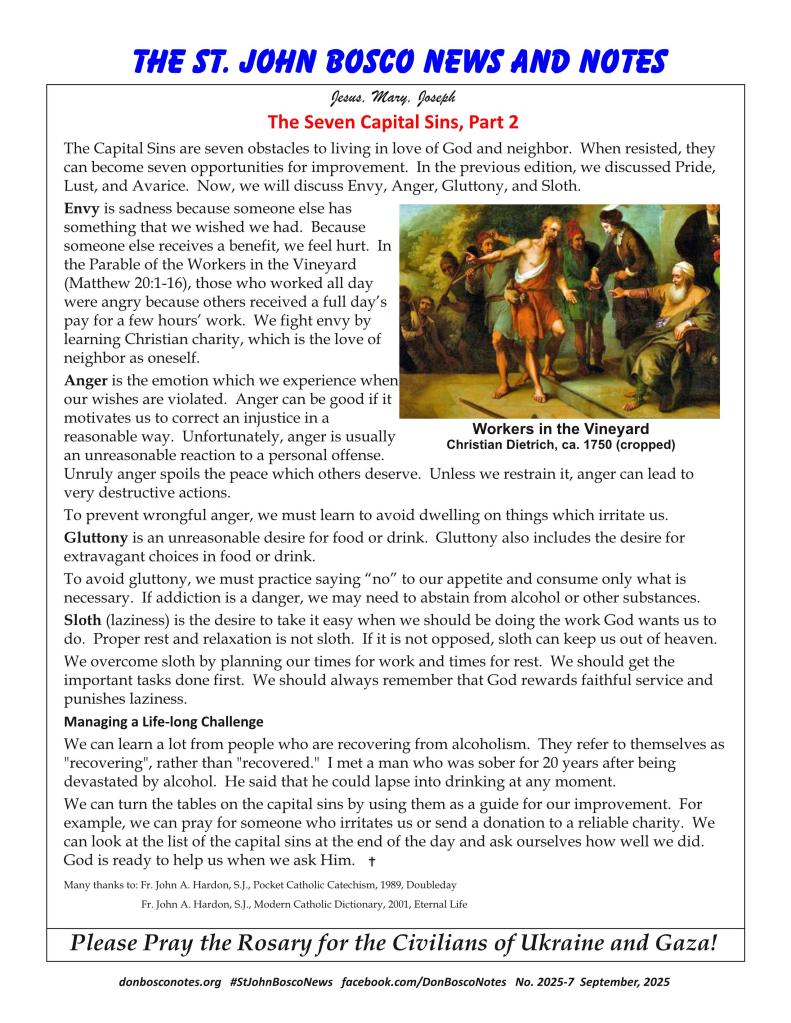
Envy is sadness because someone else has something that we wished we had. Because someone else receives a benefit, we feel hurt. In the Parable of the Workers in the Vineyard (Matthew 20:1-16), those who worked all day were angry because others received a full day’s pay for a few hours’ work. We fight envy by learning Christian charity, which is the love of neighbor as oneself.
Anger is the emotion which we experience when our wishes are violated. Anger can be good if it motivates us to correct an injustice in a reasonable way. Unfortunately, anger is usually an unreasonable reaction to a personal offense. Unruly anger spoils the peace which others deserve. Unless we restrain it, anger can lead to very destructive actions.
To prevent wrongful anger, we must learn to avoid dwelling on things which irritate us.
Gluttony is an unreasonable desire for food or drink. Gluttony also includes the desire for extravagant choices in food or drink.
To avoid gluttony, we must practice saying “no” to our appetite and consume only what is necessary. If addiction is a danger, we may need to abstain from alcohol or other substances.
Sloth (laziness) is the desire to take it easy when we should be doing the work God wants us to do. Proper rest and relaxation is not sloth. If it is not opposed, sloth can keep us out of heaven.
We overcome sloth by planning our times for work and times for rest. We should get the important tasks done first. We should always remember that God rewards faithful service and punishes laziness.
Managing a Life-long Challenge
We can learn a lot from people who are recovering from alcoholism. They refer to themselves as “recovering”, rather than “recovered.” I met a man who was sober for 20 years after being devastated by alcohol. He said that he could lapse into drinking at any moment.
We can turn the tables on the capital sins by using them as a guide for our improvement. For example, we can pray for someone who irritates us or send a donation to a reliable charity. We can look at the list of the capital sins at the end of the day and ask ourselves how well we did. God is ready to help us when we ask Him.
Many thanks to: Fr. John A. Hardon, S.J., Pocket Catholic Catechism, 1989, Doubleday
Fr. John A. Hardon, S.J., Modern Catholic Dictionary, 2001, Eternal Life
StJohnBoscoNews
 St. John Bosco News and Notes