(Plain Text Version)
Suppose someone poisoned an apple you were about to eat. This poison wasn’t lethal, but it caused you to think of yourself as better than those around you. Although you don’t want to be this way, you are now looking down on other people. You stopped saying things like: “Excuse me” and “Thank you.” You always have to have the last word in a discussion. You notice that your friends are pulling back.
You are infected with Pride. You didn’t decide to be proud, but you are proud anyway. You find it very difficult to deal with your pride, but if you don’t, it gets worse.
Pride is one of the Capital Sins.
What is a Capital Sin?
The expression, “Capital Sin” refers to sinful tendencies that everyone has. Capital sins are not specific wrongdoings we commit, but they can lead us into sin.
Why Can’t We Get Rid of Capital Sins?
The capital sins are an unfortunate result of the sin of our first parents. The sacraments, beginning with Baptism, give us strength to rise above our sinful tendencies. In heaven, we will be free of any drive toward evil. Here’s the good news: we can become holy by using God’s grace to fight the capital sins.
The Seven Capital Sins
Pride is excessive self-esteem. It is an unrealistic view of oneself. Pride is a failure to realize that God made us out of nothing. It is also a failure to be grateful for the benefits we receive from other people. The worst form of pride is to reject God’s authority in our lives.
There is a good kind of “pride.” It can be OK to be proud of a good work, especially success in overcoming obstacles. Of course, the “good” pride can turn bad when forget our place in God’s eyes.
We must pray to God that He will help us to know ourselves as we really are. We must be grateful for the humiliations that happen every day. As Servant of God John A. Hardon said many times: “We become humble through humiliations.”
Lust the disordered desire for sexual pleasure. Submitting to lust leads to every kind of sin. Lust must be resisted. Our minds and our eyes must be always under our control.
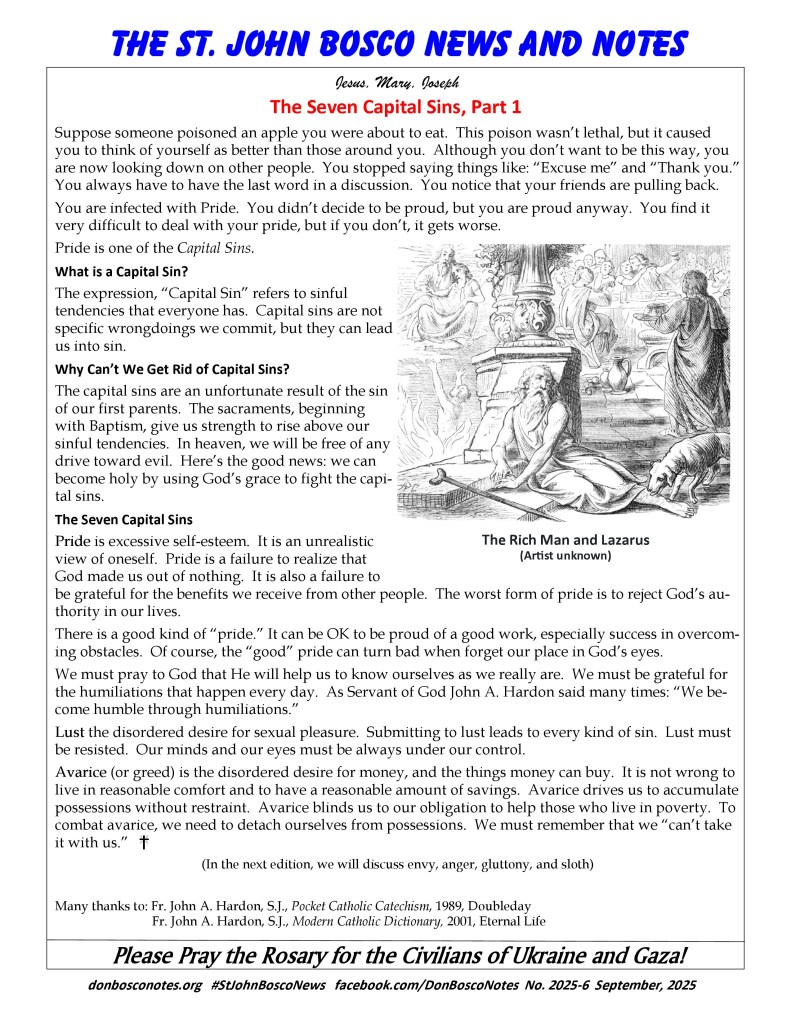
Avarice (or greed) is the disordered desire for money, and the things money can buy. It is not wrong to live in reasonable comfort and to have a reasonable amount of savings. Avarice drives us to accumulate possessions without restraint. Avarice blinds us to our obligation to help those who live in poverty. To combat avarice, we need to detach ourselves from possessions. We must remember that we “can’t take it with us.”
(In the next edition, we will discuss envy, anger, gluttony, and sloth)
Many thanks to: Fr. John A. Hardon, S.J., Pocket Catholic Catechism, 1989, Doubleday
Fr. John A. Hardon, S.J., Modern Catholic Dictionary, 2001, Eternal Life
#StJohnBoscoNews
 St. John Bosco News and Notes