(Plain Text Version)
August 4: St. John Vianney (1786-1859) – Today’s saint was a priest who served in a remote parish in France. Despite the distance, thousands of people traveled to hear him preach and to meet with him for confession.
August 6: The Transfiguration of the Lord – “Transfiguration” means to “change appearance”. Before the Crucifixion, Jesus allowed Peter, James, and John to see Him in His glory as God. This way, they could realize that Christ’s power is greater than death, and they should not be discouraged.
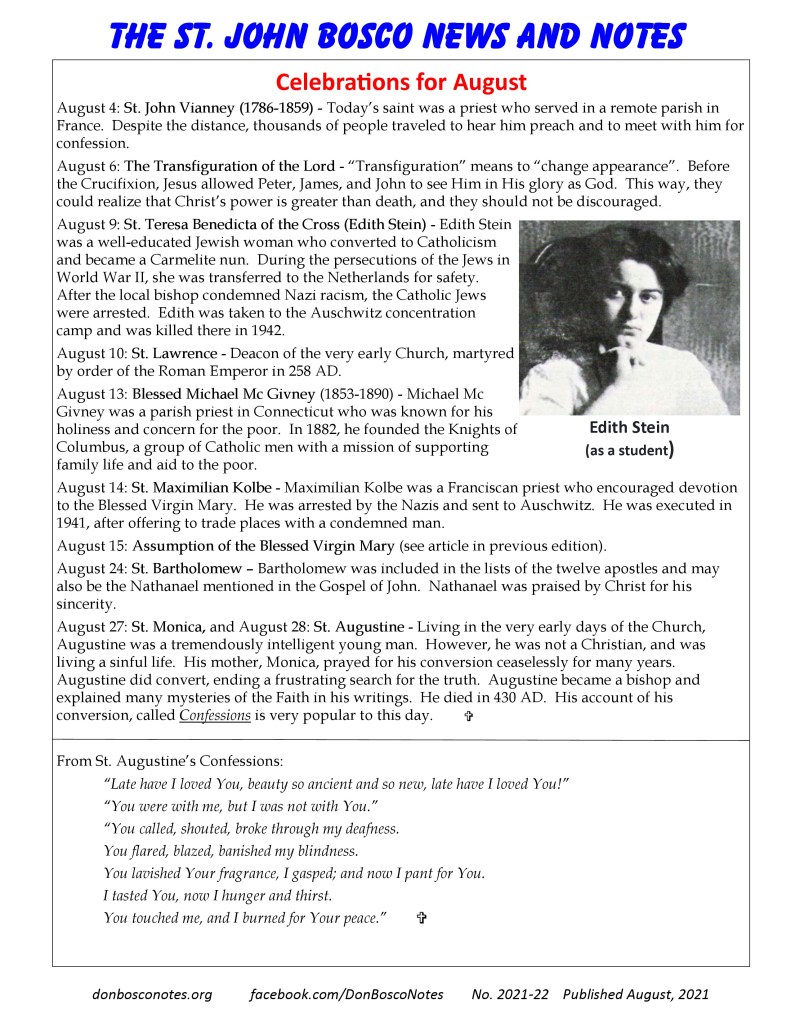
August 9: St. Teresa Benedicta of the Cross (Edith Stein) – Edith Stein was a well-educated Jewish woman who converted to Catholicism and became a Carmelite nun. During the persecutions of the Jews in World War II, she was transferred to the Netherlands for safety. After the local bishop condemned Nazi racism, the Catholic Jews were arrested. Edith was taken to the Auschwitz concentration camp and was killed there in 1942.
August 10: St. Lawrence – Deacon of the very early Church, martyred by order of the Roman Emperor in 258 AD.
August 13: Blessed Michael Mc Givney (1853-1890) – Michael Mc Givney was a parish priest in Connecticut who was known for his holiness and concern for the poor. In 1882, he founded the Knights of Columbus, a group of Catholic men with a mission of supporting family life and aid to the poor.
August 14: St. Maximilian Kolbe – Maximilian Kolbe was a Franciscan priest who encouraged devotion to the Blessed Virgin Mary. He was arrested by the Nazis and sent to Auschwitz. He was executed in 1941, after offering to trade places with a condemned man.
August 15: Assumption of the Blessed Virgin Mary (see article in previous edition).
August 24: St. Bartholomew – Bartholomew was included in the lists of the twelve apostles and may also be the Nathanael mentioned in the Gospel of John. Nathanael was praised by Christ for his sincerity.
August 27: St. Monica, and August 28: St. Augustine – Living in the very early days of the Church, Augustine was a tremendously intelligent young man. However, he was not a Christian, and was living a sinful life. His mother, Monica, prayed for his conversion ceaselessly for many years. Augustine did convert, ending a frustrating search for the truth. Augustine became a bishop and explained many mysteries of the Faith in his writings. He died in 430 AD. His account of his conversion, called Confessions is very popular to this day.
From St. Augustine’s Confessions:
“Late have I loved You, beauty so ancient and so new, late have I loved You!”
“You were with me, but I was not with You.”
“You called, shouted, broke through my deafness.
You flared, blazed, banished my blindness.
You lavished Your fragrance, I gasped; and now I pant for You.
I tasted You, now I hunger and thirst.
You touched me, and I burned for Your peace.”
 St. John Bosco News and Notes