(Plain Text Version)
St. Patrick, a Slave Who Escaped and Returned With Christ
On March 17, we celebrate the feast of St. Patrick. Although it is a great celebration of Irish culture, it is actually a feast for everyone.
Patrick was born in England in the late 4th Century AD. When he was 16 years old, he was kidnapped by bandits, and sold as a slave in Ireland.
Patrick spent 6 years in the service of a chieftain, taking care of his sheep. Patrick was a Christian, but not a very serious one. During his captivity, he prayed long and he prayed often. God gave him great comfort during this difficult time.
Patrick miraculously escaped and returned home. He gave his life to the service of the Church and became a priest.
Patrick wanted to be with the people he left behind in Ireland, both friends and enemies. The Pope shared this vision, and ordained him as bishop and sent him to Ireland.
To be a missionary to Ireland was dangerous. At that time, Ireland was a wild land inhabited by tribes led by cruel chieftains. The religion of the land was led by the Druids, who held everyone in terror by their satanic powers.
As soon as he landed on the Irish shore, Patrick converted people in great numbers. At the approach of one Easter, Patrick lit a fire to announce the beginning of the great feast. This was in defiance of the king, who opposed the celebration. When the king’s men arrived to punish the violators, they were unable to put the fire out. When they tried to hit Patrick with swords, they were unable to move.
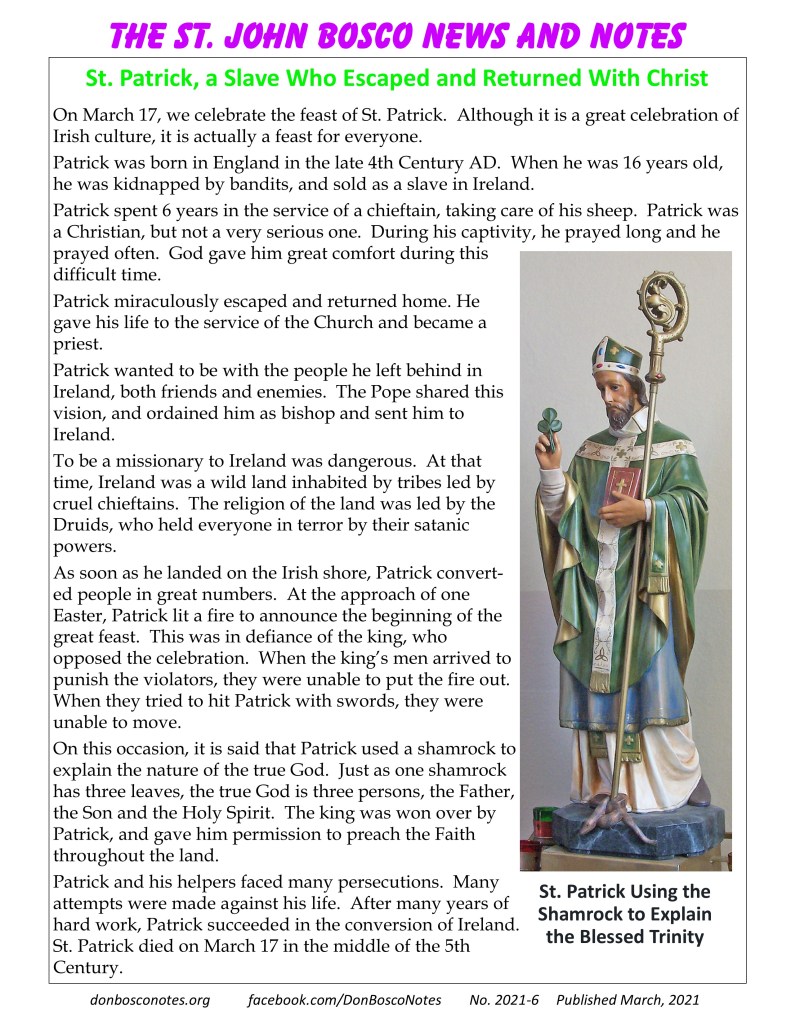
On this occasion, it is said that Patrick used a shamrock to explain the nature of the true God. Just as one shamrock has three leaves, the true God is three persons, the Father, the Son and the Holy Spirit. The king was won over by Patrick, and gave him permission to preach the Faith throughout the land.
Patrick and his helpers faced many persecutions. Many attempts were made against his life. After many years of hard work, Patrick succeeded in the conversion of Ireland. St. Patrick died on March 17 in the middle of the 5th Century.
 St. John Bosco News and Notes